
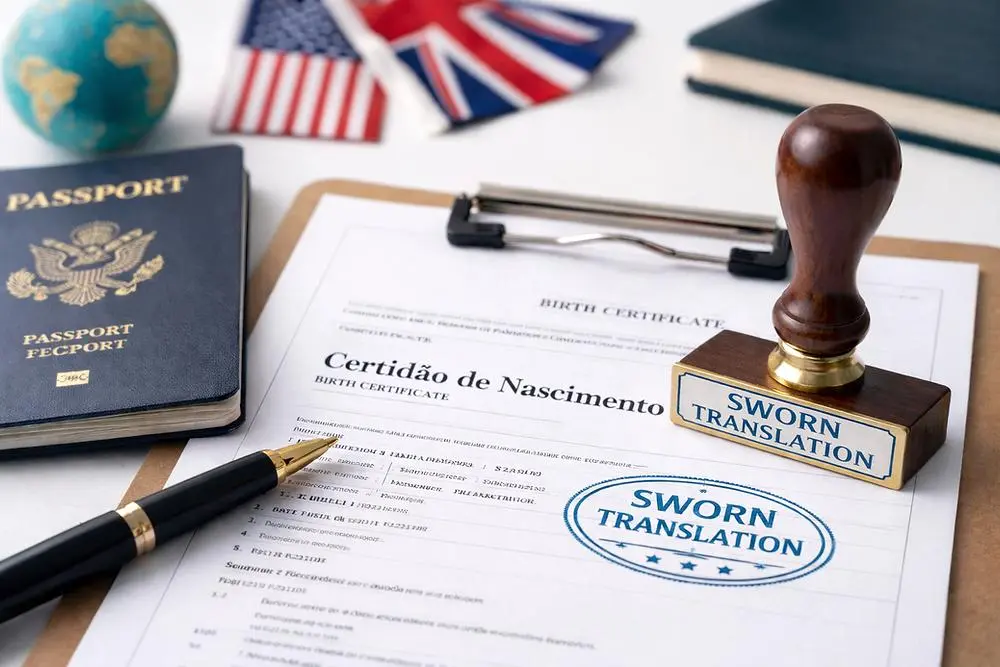

A sworn translation is an official translation produced by a translator who is legally authorized to provide this service under the regulations of the relevant country. Its purpose is to ensure that the translated content is officially recognized by public authorities, educational institutions, courts, and other organizations.
In Brazil, this service is known as tradução pública or tradução juramentada. It must be performed by a duly qualified public translator and commercial interpreter.
Unlike an ordinary translation, a sworn translation has official status and may be required for foreign documents to be legally recognized in Brazil, or for Brazilian documents to be accepted in other countries.
When Is a Sworn Translation Required?
Whether a sworn translation is necessary depends on the purpose of the document and the requirements of the institution receiving it.
In Brazil, for example, documents written in another language may need to be translated into Portuguese by a public translator before they can be submitted to government agencies, universities, courts, and other institutions.
Sworn translations may also be required for:
- Immigration and residency applications.
- Marriage and civil registration procedures.
- Academic degree recognition.
- Court and administrative proceedings.
- International business transactions and contracts.
- Submissions to government authorities.
Before commissioning a translation, it is advisable to check the specific requirements of the receiving institution.
Which Documents May Require a Sworn Translation?
Several types of documents may require a sworn translation, depending on the intended use.
Personal and civil documents
- Birth certificates.
- Marriage and divorce certificates.
- Identity documents.
- Criminal record certificates.
Academic documents
- University degrees.
- Academic transcripts.
- Certificates of study.
- Course descriptions and academic records.
Legal and business documents
- Contracts.
- Powers of attorney.
- Deeds and corporate documents.
- Court judgments.
- Commercial documentation.
Financial and administrative documents
- Bank statements.
- Tax returns.
- Certificates and accounting documents.
Not all these documents necessarily require a sworn translation in every situation. The requirement depends on the purpose of the procedure and the rules of the relevant institution or authority.
What Is the Difference Between a Sworn Translation and a Standard Translation?

The main difference is the official status of the translated document.
A standard translation can be produced by a professional translator and is commonly used for business communications, websites, technical content, marketing materials, and other documents that do not require official recognition.
A sworn translation, on the other hand, must be performed by an authorized public translator and is used when an institution or authority requires an officially recognized translation.
That is why it is important to identify how the document will be used before requesting a quote. In many cases, a professional or technical translation is sufficient. In others, a sworn translation is mandatory.
How Does the Sworn Translation Process Work?
The process generally involves the following steps:
- Document submission: the client provides a legible copy of the document to be translated.
- Assessment: the translator checks the language, length, format, and specific requirements.
- Quotation: the translator provides the price and estimated delivery time.
- Translation: the authorized public translator prepares the translation in accordance with the applicable requirements.
- Delivery: the client receives the sworn translation in the required format.
It is important to check in advance whether the receiving institution requires the original document, a certified copy, or a specific delivery format.
Does a Document Need to Be Apostilled Before It Is Translated?
Not necessarily. The Hague Apostille and sworn translation are two separate procedures.
An apostille certifies the authenticity of the signature, seal, or capacity of the authority that issued a public document, allowing it to be recognized in another country that is a member of the Hague Convention.
A sworn translation, in turn, provides an officially recognized version of the document’s content in another language.
Depending on the country and the procedure involved, both apostille certification and sworn translation may be required. The order in which they must be completed can vary according to the receiving institution’s requirements.
For this reason, it is advisable to check which documents are needed and in what order they must be submitted before starting the process.
How Much Does a Sworn Translation Cost?
The cost of a sworn translation may vary depending on several factors:
- Source and target languages.
- Document length and format.
- Delivery deadline.
- Specific submission requirements.
In Brazil, pricing criteria are subject to the regulations applicable to public translators. To receive an accurate quote, it is best to submit the document and explain the purpose for which it will be used.
How to Choose a Translation Service
When hiring a translation service, it is important to check whether the professional has experience with the relevant type of document and subject area.
You should also confirm whether the procedure requires a sworn translation or whether a specialized professional translation will be sufficient.
Choosing the right service can help avoid unnecessary expenses, delays, and problems when submitting your documents.
Conclusion
Sworn translation plays an important role in many academic, legal, immigration, and administrative procedures involving documents in different languages.
However, not every document requires this type of translation. Before commissioning the service, it is essential to check the requirements of the institution that will receive the documents.
At ConectaTalk, we provide translation and language services for businesses and individuals. Contact us to find out which service best suits your needs.