

Organizing an international event, conference, or business meeting often means bringing together people who speak different languages. To ensure that everyone can follow the discussion and participate effectively, professional language services are essential.
Simultaneous interpreting is one of the most efficient solutions for multilingual communication, allowing participants to understand a speaker in their own language while the original speech is still taking place.
But how does it work, and when should you hire this service? In this article, we explain the main features of simultaneous interpreting and what to consider when choosing professional interpreters for your event.
1. What Is Simultaneous Interpreting?
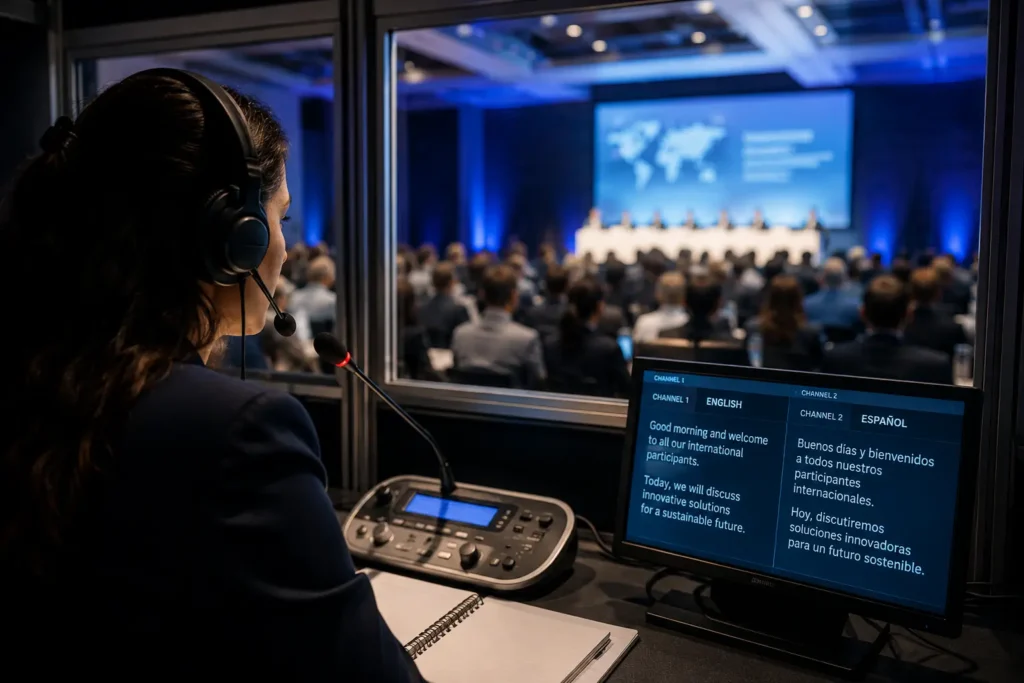
Simultaneous interpreting is a type of oral translation in which the interpreter conveys a speaker’s message into another language almost in real time.
Unlike consecutive interpreting, which requires the speaker to pause while the interpreter delivers the message, simultaneous interpreting takes place continuously, with only a few seconds of delay.
This allows presentations, conferences, seminars, and meetings to run smoothly without interrupting the speaker.
The service is commonly provided from a soundproof interpreting booth, where interpreters use professional audio equipment and headsets to listen to the speaker and deliver the interpretation through a microphone.
Participants then listen to the interpretation using wireless receivers and headphones.
2. When Should You Hire Simultaneous Interpreting?
Simultaneous interpreting is particularly suitable for events where communication needs to flow naturally and several languages are involved.
Some common situations include:
- International conferences and congresses: allowing participants from different countries to follow presentations and discussions.
- Corporate meetings: facilitating communication between international teams, executives, clients, and business partners.
- Training sessions and workshops: ensuring that employees and professionals can understand technical content in their preferred language.
- Institutional and government events: supporting communication between representatives, authorities, and international delegations.
- Product launches and business events: helping companies communicate their messages to multilingual audiences.
Whenever an event involves a large audience, a tight schedule, or continuous presentations, simultaneous interpreting can be an effective solution.
3. How Does Simultaneous Interpreting Work?

A successful simultaneous interpreting assignment requires more than language proficiency. It involves preparation, technical resources, and coordination.
The process generally includes the following elements:
Interpreter preparation
Before the event, interpreters review presentations, technical documents, terminology, and background information. This preparation is particularly important for specialized subjects such as medicine, law, technology, finance, and engineering.
Interpreting equipment
For on-site events, interpreters usually work inside soundproof booths equipped with microphones, headphones, and interpreting consoles. Participants receive the interpreted audio through wireless receivers.
Professional interpreting team
Simultaneous interpreting requires intense concentration and cognitive effort. For this reason, interpreters generally work in teams and alternate at regular intervals, depending on the assignment and working conditions.
Audio and technical coordination
Sound quality is essential. The interpreting team must be able to hear the speaker clearly, while participants need reliable access to the interpreted audio.
4. On-Site, Remote, or Hybrid Simultaneous Interpreting?
Technology has expanded the possibilities for multilingual communication. Today, simultaneous interpreting can be provided in different formats.
On-site simultaneous interpreting
Interpreters work at the event venue, usually from a soundproof booth. This format is widely used for conferences, congresses, and large corporate events.
Remote Simultaneous Interpreting (RSI)
Interpreters work remotely through a dedicated